Ava Bibbs

As part of this class, I had the amazing opportunity to experience the textile industry beyond the classroom. Throughout the trip, we followed different parts of the textile supply chain, from cotton farming and fiber processing to product development, manufacturing, testing, recycling, and circularity. We visited companies and organizations across North Carolina, learned directly from the people working in the industry, and saw how each part connects. This experience gave me a new perspective on where our clothing comes from, what happens after we are done with it, and the amount of work that happens in between.


Click on Each Image to View My Insta Posts!


Our visit to Mystery’s Meadow Alpacas & Artisan Fiber Mill in Humboldt, Iowa, gave us the opportunity to see the fiber production process firsthand. During the visit, we heard directly from owners Tom and Bertie Wilson and learned how alpaca fiber goes from freshly sheared fiber to finished yarn. We were able to follow the process through each step, including picking, separating, carding, spinning, dyeing, and blending. We also learned that the mill processes fibers sent in by customers from across the country and creates products including yarn, roving, batts, and felt.
One of my biggest takeaways was getting to see processes I have learned about in my textile science and other Fashion Design and Merchandising courses actually come to life. Seeing the equipment in action and the fiber change throughout each step gave me a much better understanding of how much goes into creating a finished textile. This visit helped connect what I have learned in the classroom to the real production process and gave me a new appreciation for the time, knowledge, and craftsmanship behind the materials we use in the fashion industry.
Field Trip to Overflow
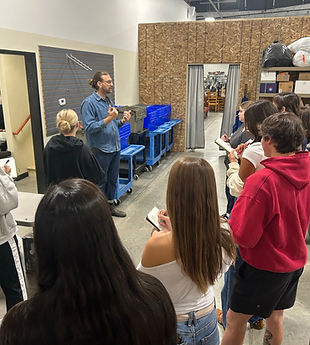

Our visit to Overflow Thrift Store, a local nonprofit in Ames, Iowa, was especially meaningful because it is where I have donated my unwanted clothing throughout college. During the visit, we heard directly from Overflow’s Senior Operations Director and got a behind the scenes look at what happens after donations are dropped off. We learned how items are sorted to be resold, recycled, or passed along to other organizations. I learned that Overflow resells and recycles more than 600,000 pounds of material each year that could otherwise end up in a landfill.
One of my biggest takeaways was how important accessibility is to sustainability. Making donating easy and convenient encourages more people to do it, which is exactly what Overflow provides for the Ames community. Seeing the process firsthand was so fascinating and showed me how much of an impact resale and textile recycling can have when people are given an easy way to participate. This visit made sustainability feel much more realistic and showed me how simple actions are make a meaningful difference.